
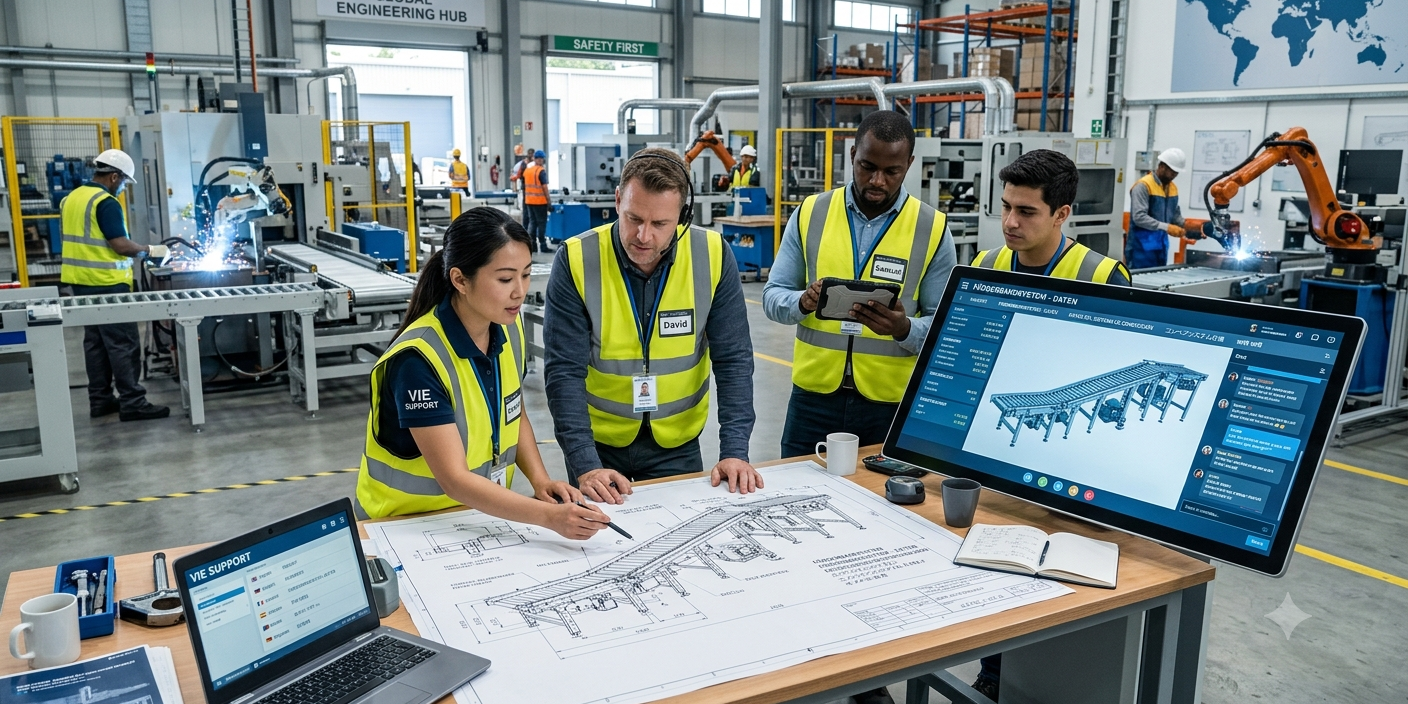
Manufacturing & Engineering Translation Challenges: What Businesses Need to Know
From technical manuals and engineering drawings to safety documentation and product specifications, accurate translation is essential for manufacturers and engineering companies operating across global markets.
Manufacturing and engineering companies operate in an increasingly global environment. Products may be designed in one country, manufactured in another, and sold, installed, or serviced across several international markets. This creates a significant need for accurate multilingual technical communication. Unlike general business content, engineering and manufacturing documents often contain specialized terminology, measurements, safety instructions, specifications, diagrams, and process information where even a small error can have serious consequences. At Vie Support Language Services Pvt. Ltd., we support businesses with professional translation, localization, multilingual DTP, proofreading and other language solutions for technical and industrial content. In this article, we explore the key translation challenges faced by manufacturing and engineering companies and how businesses can manage them effectively.
Why Translation Matters in Manufacturing and Engineering
For a manufacturing or engineering company, language is closely connected to product quality, safety, compliance and operational efficiency.
Consider a manufacturer exporting industrial equipment to another country.
The machine itself may be designed and manufactured correctly, but the customer also needs to understand:
- How to install it
- How to operate it
- How to maintain it
- What safety precautions to follow
- How to troubleshoot problems
- What specifications apply
- Which replacement parts are required
If this information is poorly translated, the consequences can go far beyond an awkward sentence.
Incorrect technical communication can result in:
- Equipment misuse
- Safety incidents
- Product returns
- Customer complaints
- Installation delays
- Increased support costs
- Compliance problems
- Damage to brand reputation
For this reason, manufacturing translation is not simply a language exercise. It is an important part of technical communication and risk management.
7 Major Manufacturing & Engineering Translation Challenges
1: Complex Technical Terminology
Manufacturing and engineering documents contain terminology that may not have a straightforward equivalent in another language.
Examples include:
- Mechanical engineering terminology
- Electrical and electronic terms
- Automotive terminology
- Industrial automation
- Robotics
- HVAC
- CNC machinery
- Materials and metallurgy
- Process engineering
- Quality control terminology
A general translator may understand the source language but may not understand the engineering context.
This is why technical translation should be handled by linguists who understand both the language and the subject matter.
2: Maintaining Terminology Consistency
Large manufacturing companies may have thousands of technical terms appearing across multiple documents.
The same component, process, machine or function should ideally be translated consistently throughout:
- User manuals
- Installation guides
- Product catalogues
- Engineering specifications
- Websites
- Training materials
- Service documentation
Inconsistent terminology can confuse users and create additional work for technical teams.
A professional translation workflow should therefore include terminology management and approved glossaries.
This becomes especially important when a company updates its documentation regularly.
3: Technical Manuals and Safety Instructions
Technical manuals are among the most sensitive documents requiring translation.
They may contain:
- Operating procedures
- Warning messages
- Safety instructions
- Maintenance procedures
- Troubleshooting instructions
- Installation requirements
- Emergency procedures
A translation must preserve the original meaning while making the instructions clear to the target-language reader.
The translator should never make assumptions about technical instructions or simplify content in a way that changes its meaning.
For safety-critical content, linguistic accuracy and appropriate review are essential.
4: Engineering Drawings, Tables and Specifications
Engineering documents are rarely just blocks of text.
They may contain:
- Engineering drawings
- Tables
- Charts
- Labels
- Callouts
- Product specifications
- Captions
- Diagrams
- Measurement units
This creates an additional challenge: the translated content must fit correctly into the original document layout.
Some languages require more or less space than the source language. Text expansion can therefore affect tables, diagrams, brochures and manuals.
This is where multilingual DTP and typesetting become important.
The translation is not complete simply because the text has been translated. The final document must also be visually accurate and usable.
5: Units, Numbers and Regional Conventions
Manufacturing and engineering documents frequently contain measurements and numerical information.
Depending on the target market, businesses may need to consider:
- Metric and imperial measurements
- Decimal conventions
- Date formats
- Currency
- Temperature units
- Pressure units
- Dimensions
- Electrical specifications
These elements require careful handling because changing or incorrectly interpreting a technical value can have serious consequences.
A professional localization process should establish clear rules for how measurements and numerical information are handled before translation begins.
6: Regulatory and Compliance Requirements
Manufacturers entering international markets may need to translate documentation associated with local regulations, certifications, safety requirements and product compliance.
Depending on the product and destination market, documentation may include:
- Safety documentation
- Product labels
- Technical files
- Declarations
- Installation instructions
- User manuals
- Compliance documentation
- Warranty information
Translation alone does not guarantee regulatory compliance. However, using qualified language professionals and appropriate review processes helps reduce the risk of linguistic errors affecting compliance documentation.
7: Managing Large Volumes of Multilingual Content
A manufacturer launching a product internationally may need to translate hundreds or thousands of files.
These could include:
- Product manuals
- Datasheets
- Brochures
- Websites
- Training content
- Software interfaces
- Marketing materials
- Installation guides
- Service documentation
Managing multiple languages simultaneously requires more than individual translators.
It requires:
Project management → terminology management → translation → review → DTP → quality assurance → final delivery
An experienced language service provider can coordinate these activities under a structured workflow.
Why General Translation Is Not Always Enough
Manufacturing and engineering content requires a different approach from general business translation.
A technical translation project should ideally consider:
Subject-Matter Expertise
The linguist should understand the technical field and terminology.
Native-Language Fluency
The final content should read naturally to users of the target language.
Terminology Management
Key technical terms should remain consistent throughout the project.
Quality Assurance
Translated content should undergo appropriate linguistic and technical review.
DTP and Formatting
The translated document should maintain its usability and visual structure.
This combination helps turn a translated document into business-ready technical communication.
How Vie Support Supports Manufacturing & Engineering Companies
At Vie Support Language Services Pvt. Ltd., we understand that manufacturing and engineering translation requires more than linguistic fluency.
Our language solutions can support a wide range of industrial content, including:
- Technical manuals
- User guides
- Installation manuals
- Engineering documentation
- Product specifications
- Datasheets
- Product catalogues
- Safety documentation
- Training materials
- Websites
- Software interfaces
- Marketing collateral
Our broader multilingual capabilities include:
Translation | Localization | Proofreading & Editing | Multilingual DTP | Interpretation | Voice-over | Subtitling
With 18+ years of industry experience, an ISO 9001:2015 certified quality management process, native-language resources across 100+ languages, and dedicated project management, Vie Support can help manufacturing and engineering organizations manage multilingual content more systematically.
Manufacturing Translation Checklist
Before starting a technical translation project, businesses should ask:
Technical Content
⇒ Has the source document been reviewed for technical accuracy?
⇒ Have key technical terms been identified?
Linguists
⇒ Are the translators experienced in the relevant engineering or manufacturing domain?
⇒ Are native-language linguists being used?
Terminology
⇒ Is there an approved glossary?
⇒ Will terminology remain consistent across future documents?
Formatting
⇒ Does the project require multilingual DTP?
⇒ Have diagrams, tables and graphics been considered?
Quality
⇒ Will the translation be proofread or reviewed?
⇒ Is there a final quality assurance process?
Technology
⇒ Can AI or translation technology improve efficiency without compromising quality?
Scalability
⇒ Can the language partner support additional languages and future product updates?
This checklist can help companies identify potential translation risks before production begins.
Manufacturing and engineering translation is fundamentally different from translating general business content. Technical terminology, safety instructions, engineering specifications, diagrams, measurements, regulatory information and formatting all need to be handled carefully.
As manufacturing companies expand across borders, the ability to communicate technical information accurately becomes increasingly important.
A well-structured technical translation process can help businesses improve customer understanding, support regulatory requirements, reduce avoidable communication errors and maintain consistency across international markets.
For manufacturers and engineering companies, professional translation should therefore be viewed not simply as a language requirement, but as an important part of global product communication and customer experience.
Need Technical Translation for Your Manufacturing Business?
Whether you need a single technical manual translated or a multilingual documentation program managed across several markets, Vie Support Language Services Pvt. Ltd. can support your requirements.
Our team can assist with technical translation, localization, multilingual DTP, proofreading, interpretation, voice-over and subtitling across 100+ languages.
Have a technical translation requirement?
Talk to Vie Support’s Language Experts
Share your document, language requirements and target market with our team, and we’ll help you identify the right multilingual solution for your project.
Frequently Asked Questions
What is manufacturing translation?
Manufacturing translation involves translating technical and business content used by manufacturing companies, including manuals, specifications, product documentation, safety instructions, catalogues and training materials.
Why is engineering translation different from general translation?
Engineering content contains specialized terminology, technical specifications, measurements, diagrams and safety information. It therefore requires linguists with appropriate technical knowledge and a structured quality review process.
What documents can be translated for manufacturing companies?
Common documents include technical manuals, installation guides, operating instructions, datasheets, engineering specifications, safety documentation, product catalogues, training materials and websites.
Is AI translation suitable for technical documents?
AI can improve the speed and efficiency of technical translation, particularly for repetitive content. However, human review remains important for technical terminology, context, safety-related information and quality assurance.
Why is multilingual DTP important for engineering translation?
Translated text may expand or contract compared with the source language. Multilingual DTP ensures that tables, diagrams, graphics, fonts and page layouts remain usable and professionally formatted.