
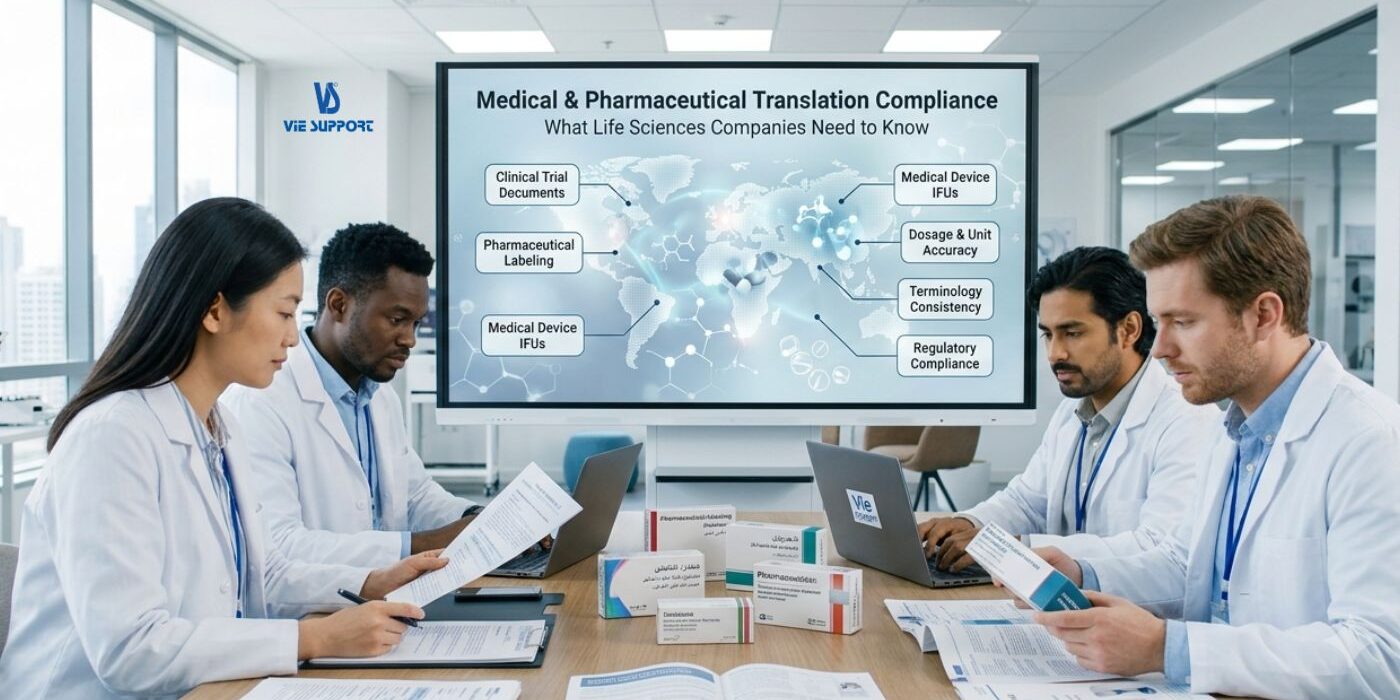
Medical & Pharmaceutical Translation Compliance: What Life Sciences Companies Need to Know
From clinical trial documents and patient information leaflets to pharmaceutical labels and medical device instructions, accurate multilingual communication is essential for patient safety, regulatory readiness and global market access.
The pharmaceutical and healthcare industries operate in a highly regulated environment where even a small documentation error can have significant consequences. As companies expand into international markets, they must communicate complex medical and scientific information across languages while maintaining accuracy, consistency and compliance with applicable local requirements.
Medical and pharmaceutical translation is therefore much more than converting text from one language into another. It requires subject-matter knowledge, carefully controlled terminology, documented quality processes and an understanding of the intended audience. Whether translating clinical trial protocols, informed consent forms, drug labels or medical device instructions, organizations need a structured approach to multilingual content management.
For life sciences businesses, choosing an experienced language services partner can help reduce communication risks and support the accurate preparation of multilingual documentation.
Why Is Translation Compliance Important in the Medical and Pharmaceutical Industry?
Medical and pharmaceutical documents communicate information that can directly influence patient decisions, treatment administration, clinical research and the safe use of medical products.
An inaccurate translation may result in:
⇒ Incorrect understanding of dosage instructions or precautions.
⇒ Misinterpretation of adverse reactions and safety warnings.
⇒ Incomplete or unclear informed consent.
⇒ Inconsistencies between approved product information and translated materials.
⇒ Confusion among healthcare professionals, patients and clinical research participants.
⇒ Delays in document approval, product launch or clinical trial activities.
Translation quality is consequently connected to patient safety, document integrity and the organization’s broader regulatory responsibilities.
It is important to understand that there is no single global translation regulation covering every medical document. Requirements depend on the document type, product category, destination market and applicable regulatory framework. Organizations should confirm the relevant requirements with their regulatory and quality teams.
Which Medical and Pharmaceutical Documents Require Translation?
Companies operating across international markets may need to translate a wide range of scientific, clinical, regulatory and patient-facing documents.
1. Clinical trial documentation
Clinical research organizations and pharmaceutical sponsors often manage multilingual documentation throughout the clinical trial lifecycle.
Common documents include:
- Clinical trial protocols and amendments
- Informed consent forms (ICFs)
- Patient information sheets
- Investigator brochures
- Clinical study reports
- Patient diaries and questionnaires
- Recruitment materials
- Adverse event and safety reporting documents
Informed consent materials require particular care. Participants must be able to understand the information relevant to their decision to participate. ICH E6(R3) Good Clinical Practice emphasizes informed, voluntary consent and the importance of providing participants with appropriate information. Translation must preserve the meaning of the source while making the information understandable to the intended population.
2. Pharmaceutical product information and labelling
Pharmaceutical manufacturers may require translation of:
- Product labels and packaging text
- Package inserts
- Patient information leaflets
- Summary of Product Characteristics (SmPC)
- Dosage and administration instructions
- Contraindications and precautions
- Storage conditions
- Pharmacovigilance and safety communications
These documents contain terminology and instructions that must remain consistent across languages. Particular attention should be given to dosage units, frequency, routes of administration, warnings, contraindications and product-specific terminology.
3. Medical device documentation
Medical device manufacturers entering international markets may need to translate:
- Instructions for Use (IFUs)
- Device labels and packaging
- Safety notices and field safety communications
- Technical documentation
- User manuals
- Product specifications
- Software and user-interface content
For products sold in the European Union, language requirements under the Medical Device Regulation (MDR) and In Vitro Diagnostic Regulation (IVDR) can vary by Member State. The European Commission provides country-level language requirement information to help manufacturers understand the requirements for accompanying information and instructions.
4. Healthcare and medical communication
Other documents that may require specialist translation include:
- Patient medical records
- Discharge summaries
- Diagnostic reports
- Laboratory reports
- Medical questionnaires
- Healthcare training materials
- Medical research publications
- Hospital policies and clinical guidelines
The terminology, tone and level of explanation must be appropriate for the intended reader—whether a physician, researcher, healthcare professional or patient.
Major Compliance Challenges in Medical Translation
1. Medical terminology and scientific accuracy
Medical documents contain specialized terminology, abbreviations, drug names, anatomical terms, clinical measurements and scientific expressions.
A general translator may understand the language but lack the subject knowledge required to interpret the medical context correctly.
How to manage it: Assign documents to qualified linguists with relevant medical, pharmaceutical or life sciences experience. Use approved terminology resources and subject-matter review for critical content.
2. Dosage, units and numerical accuracy
A misplaced decimal point, incorrectly converted unit or ambiguous frequency instruction can change the meaning of a medical instruction.
For example, dosage expressions, concentrations, measurement units and administration frequencies must be handled with particular care.
How to manage it: Establish specific review checks for numbers, units, dates, dosage instructions, decimal separators and symbols. Do not make assumptions or convert units without client authorization and appropriate scientific review.
3. Patient comprehension and informed consent
Clinical trial participants need to understand the purpose, procedures, potential risks and other relevant information before deciding whether to participate.
A technically accurate translation may still be difficult for a patient to understand if it uses overly complex sentence structures or unfamiliar terminology.
How to manage it: Use language appropriate to the target population, preserve the approved meaning and follow the sponsor’s or study team’s requirements for readability review and approval.
4. Regulatory differences between countries
A document accepted in one market may need changes before it can be used in another. Language requirements, labelling conventions and document expectations can differ across jurisdictions.
For example, the European Commission’s MDR and IVDR language requirement resources show that manufacturers need to consider the specific requirements of the Member States where their products are made available.
How to manage it: Identify destination markets before translation begins. Have regulatory specialists confirm the applicable language, formatting and submission requirements rather than relying on a generic multilingual template.
5. Terminology consistency across documents
A pharmaceutical product may have hundreds of related documents, including labels, clinical materials, product information and safety communications.
If the same medical term is translated differently across documents, readers may become confused and document reviews may become more complicated.
How to manage it: Maintain client-approved glossaries, terminology databases and translation memories. Apply terminology consistently across related projects and document versions.
6. Document formatting and multilingual layout
Medical and pharmaceutical content often includes tables, dosage charts, diagrams, labels, symbols, footnotes and structured forms.
Text expansion or font compatibility issues can affect the layout after translation. In some cases, important warnings or instructions may become difficult to read.
How to manage it: Include multilingual desktop publishing (DTP), layout checks and final document quality assurance where required. Verify that translated content remains legible and correctly positioned.
7. Confidentiality and sensitive information
Clinical trial documents, patient records, unpublished research and pharmaceutical product information may contain confidential or sensitive data.
Organizations must consider how documents are shared, stored, accessed and processed throughout the translation workflow.
How to manage it: Use appropriate confidentiality agreements, restricted access, secure transfer methods, controlled file handling and documented vendor procedures. Personal data processing must also follow applicable privacy and data-protection requirements.
What Does a Reliable Medical Translation Quality Process Look Like?
A structured quality process helps organizations manage linguistic accuracy and reduce the risk of avoidable errors.
A typical workflow may include the following stages:
Step 1: Document assessment
Review the source files, document purpose, target audience, language requirements, destination markets and project-specific instructions.
Step 2: Specialist linguist selection
Assign translators with relevant medical, pharmaceutical, clinical research or medical device experience.
Step 3: Terminology preparation
Identify key terms, abbreviations, product names and client-approved translations. Resolve terminology queries before or during translation through an agreed process.
Step 4: Translation
Translate the content while preserving scientific meaning, context, structure and intended use.
Step 5: Independent review
Arrange a second-person linguistic review or subject-matter review according to the document’s risk level and the client’s quality requirements.
Step 6: Formatting and DTP
Check tables, diagrams, labels, page layouts, fonts, symbols and text placement in the translated document.
Step 7: Final quality assurance
Perform checks for omissions, consistency, numerical accuracy, formatting issues and compliance with the agreed project instructions.
Step 8: Delivery and version control
Deliver the approved files with appropriate version identification and maintain project records according to the agreed quality and retention procedures.
The precise workflow should be proportionate to the document’s purpose and risk. Not every document requires the same review stages, but critical patient-facing and regulatory content deserves clearly defined checks.
The Role of AI and Machine Translation in Medical Translation
Artificial intelligence and machine translation can help organizations process large volumes of multilingual content. They may be useful for certain preliminary or lower-risk tasks when used under an approved process.
However, medical and pharmaceutical content requires careful control. AI-generated translations may mishandle medical terminology, dosage expressions, abbreviations, context-specific meanings and safety-critical instructions.
Organizations should consider:
⇒ Whether the content is permitted for processing by the selected AI or machine translation system.
⇒ Whether confidential or personal information could be exposed.
⇒ Whether the system is approved for the intended use.
⇒ Whether a qualified human reviewer is required.
⇒ Whether terminology and numerical checks are included.
⇒ Whether the final output is traceable and appropriately approved.
For high-risk medical, clinical and regulatory documents, AI output should not be treated as automatically accurate or ready for use. The level of human review and validation should be defined by the organization’s quality and regulatory procedures.
How Vie Support Helps with Medical and Pharmaceutical Translation
Vie Support Language Services Private Limited supports organizations that need accurate, consistent and professionally managed multilingual communication.
With experience in language services, Vie Support can support medical and pharmaceutical organizations with:
Medical and pharmaceutical translation: Translation of clinical, scientific, healthcare and pharmaceutical documentation.
Clinical trial document translation: Support for informed consent forms, patient information sheets, protocols and related study materials.
Medical device translation: Translation of user manuals, instructions for use, product labels and technical documentation.
Proofreading and editing: Linguistic review to improve clarity, consistency and accuracy.
Multilingual DTP and typesetting: Formatting translated documents, tables, labels and other structured content.
Terminology management: Consistent use of approved medical and product terminology across projects.
Multilingual voice-over and subtitling: Language support for healthcare training and educational content.
Vie Support follows an ISO 9001:2015-certified quality management system. Project workflows can be aligned with client-specific instructions, confidentiality expectations, review requirements and delivery procedures.
The appropriate scope of linguistic review, technical review and regulatory approval should be agreed with the client for each project. Translation services support the documentation process but do not replace the regulatory responsibilities of manufacturers, sponsors or healthcare organizations.
Medical Translation Compliance Checklist for Businesses
Before appointing a translation partner or starting a multilingual medical documentation project, consider the following checklist:
♦ Identify the document type and intended audience.
♦ Confirm the destination countries and applicable language requirements.
♦ Select linguists with relevant medical or pharmaceutical expertise.
♦ Provide approved glossaries and reference documents.
♦ Define review and approval responsibilities.
♦ Verify dosage, units, numbers, warnings and safety information.
♦ Check terminology consistency across related documents.
♦ Include multilingual DTP and layout verification where required.
♦ Establish confidentiality and secure file-handling procedures.
♦ Maintain version control and project records.
♦ Obtain final approval from the responsible client or regulatory team.
Conclusion
Medical and pharmaceutical translation is an important part of communicating scientific and healthcare information across international markets. From clinical trial participation and patient information to pharmaceutical labelling and medical device instructions, every translated document must preserve the meaning and intended use of the original content.
A structured translation workflow, specialist linguists, terminology management, appropriate review and careful document handling can help organizations reduce communication risks and manage multilingual documentation more effectively.
For life sciences companies, choosing a language services partner with relevant subject-matter experience and a defined quality management process is an important step towards dependable multilingual communication.
Need Reliable Medical and Pharmaceutical Translation Support?
Vie Support provides professional translation, proofreading, multilingual DTP and other language solutions for organizations managing complex multilingual content.