
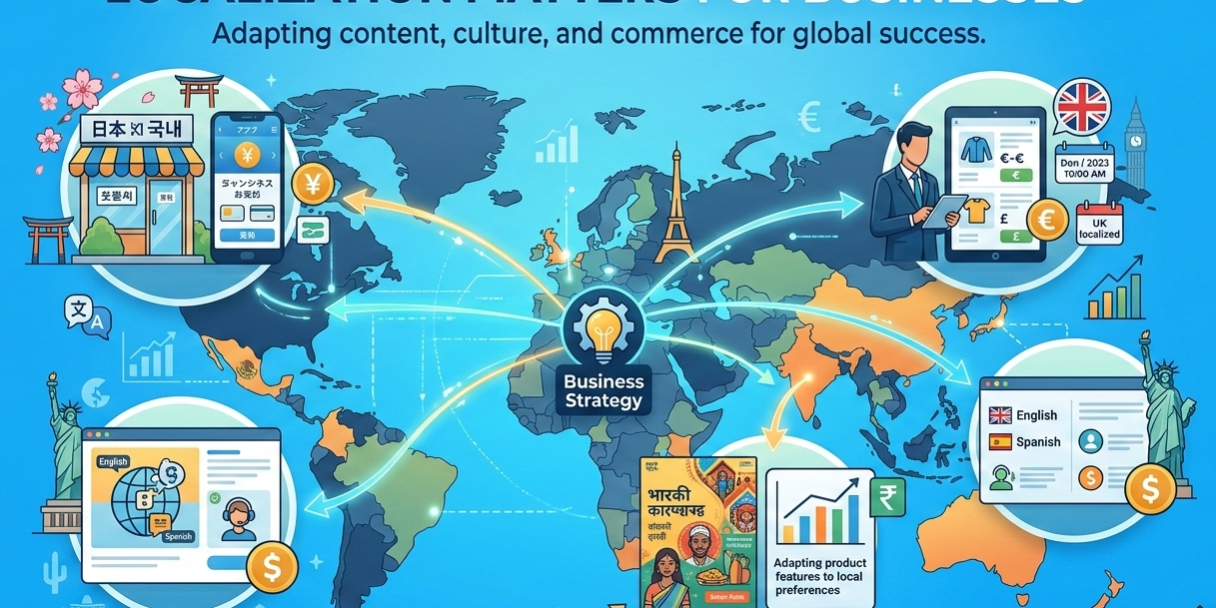
Why Companies Fail in Global Expansion Because of Poor Localization
(Real Business Risks Explained)
A company launches its software product in a new country after months of preparation.
The interface is translated. Marketing campaigns are running. Initial downloads look promising.
Within two weeks the support tickets start increasing.
Users say the instructions are confusing.
Some customers misunderstand the payment terms.
A few even believe the product violates local regulations.
Nothing is technically wrong with the product.
The real problem is language – but not grammar.
It is localization.
Many organizations assume translation is the final step before entering an international market. In reality, it is one of the most critical operational steps. Poor localization does not merely affect readability; it directly affects user trust, compliance, and revenue.
Translation vs Localization – The Difference Businesses Often Overlook
Translation converts words from one language to another.
Localization adapts a product, communication, or documentation to match how people in a specific country understand, use, and trust information.
| Translation | Localization |
| Focus on linguistic accuracy | Focus on user understanding |
| Word conversion | Cultural, legal and usability adaptation |
| Text only | Text + layout + context + intent |
| Works for internal communication | Required for customers and markets |
For example:
A literal translation of a warranty statement may be linguistically correct but legally invalid in another country. A UI button label might be grammatically accurate but culturally confusing.
This gap is where most global expansion efforts fail.
The Hidden Business Risks of Poor Localization
Localization problems rarely appear immediately. They surface only after customers start using the product — when correction becomes expensive.
- Compliance and Legal Risk
Regulatory documents, user agreements, privacy policies and product labels must follow local legal interpretation, not just language accuracy. Incorrect wording can result in product rejection, delayed approvals or legal notices.
- Software and App Store Rejection
Mobile applications are frequently rejected because instructions, permissions or payment descriptions are not properly localized. App stores evaluate clarity and user understanding, not grammar quality.
- E-commerce Returns and Customer Complaints
Misinterpreted product specifications, sizes, instructions or safety information increase refund requests and support tickets. This directly increases operational cost.
- Marketing Campaign Failure
Brand messages that work in one country may sound unnatural, overly direct or even inappropriate in another. A campaign may technically run successfully but produce almost zero conversions.
- Brand Reputation Damage
Customers often share confusing or incorrect translations on social media. Once trust is affected, reputation recovery takes much longer than translation correction.
Localization is therefore not a marketing activity.
It is a risk-management activity.
Industries Most Affected by Localization Errors
Organizations dealing with regulated information or customer instructions face higher impact.
- SaaS and Software Platforms
- Fintech and Financial Services
- Medical Devices and Healthcare
- Manufacturing Exporters
- E-learning Platforms
- Legal and Compliance Documentation Providers
In these sectors, unclear language does not only confuse users — it can prevent adoption.
Why Many Companies Choose the Wrong Translation Vendor
Many localization failures occur not because companies ignore language, but because they underestimate its complexity.
Common issues include:
- Use of general translators without subject expertise
- Over-reliance on machine translation without human review
- Lack of terminology consistency across documents
- No proofreading or quality assurance workflow
- No testing of translated software interface or layouts
Translation becomes a checklist task instead of a controlled process.
What a Proper Localization Workflow Should Include
A structured localization approach typically involves:
- Subject-matter linguists familiar with the industry
- Terminology planning before translation begins
- Multi-stage proofreading and review
- Formatting and layout adaptation
- Software or document usability verification
- Consistency across manuals, UI, marketing and legal content
When these steps are followed, the translated material feels natural to the user rather than “translated”.
Before Entering a New Market
Before launching a product, website or documentation internationally, it is useful to evaluate whether the content is market-ready from a language and usability perspective.
A localization readiness review helps identify:
- unclear customer instructions
- culturally unsuitable phrasing
- compliance wording risks
- user interface misunderstandings
Addressing these early is significantly less expensive than correcting after launch.
Conclusion
Global expansion does not fail because companies lack good products.
It often fails because customers cannot confidently understand them.
Localization is not a linguistic expense – it is a business protection strategy.
Organizations that treat language as part of product quality typically see smoother adoption, lower support costs and stronger customer trust in new markets.
Ready to build trust in global markets?
Let’s make your brand fluent in opportunity.
FAQ’s
What is the difference between translation and localization?
Translation converts text into another language. Localization adapts the message, context, format and usability so users in a specific country can clearly understand and trust the information.
Why is localization important for software products?
Software interfaces, instructions and payment explanations must match user expectations and legal interpretation. Without localization, users may misunderstand features or abandon the application.
Can machine translation alone be used for business documents?
Machine translation can assist with speed, but business-critical, legal or customer-facing documents require human review to ensure accuracy, clarity and compliance.
Which industries require localization the most?
SaaS, fintech, healthcare, manufacturing exporters and e-learning companies depend heavily on localization because they communicate complex instructions and regulated information.
When should localization be done in a project?
Localization should begin before market launch. Correcting language issues after release is costlier and may affect customer trust.